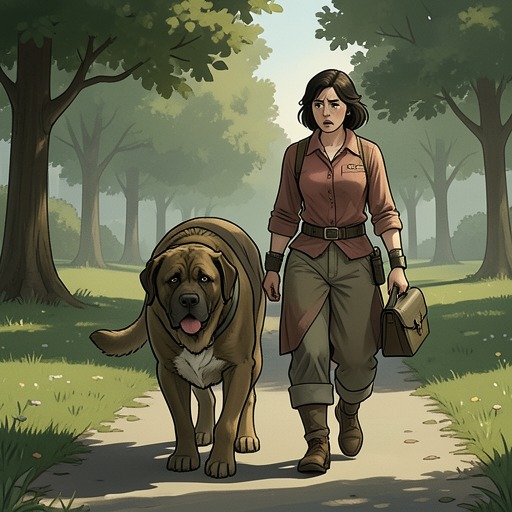
Apollo’s old age and physical decline
The FriendApollo’s old age and physical decline make the limits of the narrator’s ability to protect him newly visible. The gray hairs on his muzzle, redness around his eyes, worsening arthritis, and increasingly difficult movement transform ordinary care into a vigil: the narrator must watch for signs of deterioration while confronting the possibility that love will eventually require a decision about his death.
Signs of Aging and the Fear of Loss
At a checkup, the veterinarian gives the narrator a list of common signs of illness and decline in senior dogs. The list overwhelms her, not least because it turns Apollo’s aging into a series of possible future emergencies. In the six months between appointments, his arthritis has worsened. Some days he walks stiffly; sometimes he needs two attempts to rise. The physical changes are small enough to be observed one by one, yet together they make the prospect of losing him immediate.
The narrator has already escaped one feared disaster: separation from Apollo or eviction connected with keeping him. But that reprieve cannot satisfy her. She wants not merely another summer, or several more, but for Apollo to live as long as she does. The wish exposes the emotional asymmetry of their bond: the narrator can imagine a future in which she survives him, but cannot accept that future as fair. His aging therefore brings relief and dread into collision. Having kept him close, she must now face the suffering and separation that keeping him safe could never prevent.
What Apollo Knows
Apollo’s decline also prompts questions the narrator recognizes she cannot answer. Animals may not understand in advance that they will die, she reflects, yet many seem to know when death is near. She wonders when such awareness might begin, whether an animal can sense the meaning of aging, and how bewilderment or intuition might shape that experience. The narrator calls these questions foolish, but their persistence shows that uncertainty is part of her care: she wants to understand Apollo’s experience even while knowing she cannot enter it.
When the narrator is distressed by thoughts of his future, Apollo sometimes turns his attention toward her, as if drawing her away from them. The gesture offers comfort without resolving the central uncertainty. The narrator cannot know exactly what he understands, including how he experiences his own strength. During tug-of-war with his favorite toy, a bright red rubber tug toy, Apollo makes mock monster-dog noises, but seems to take most pleasure in letting the narrator win. His apparent restraint gives their play a tenderness that contrasts with his physical vulnerability, without proving what he knows or intends.
Movement, Care, and Dependence
The narrator continues taking Apollo to the dog park, although she has lost hope that he will play there. He shows little interest in other dogs or people, and this still bothers her: the park presents opportunities for sociability that he does not take. His preferences and limits resist the narrator’s hopes for him, just as his aging resists her wish to keep their life unchanged.
Walking is also necessary care, not simply recreation. The veterinarian says Apollo must get at least some exercise every day, even as walking becomes harder. At the beach, a few minutes away, the narrator takes him only in the early morning or at dusk. Their first trip prompts uncertainty about whether he has seen the ocean, swum, or walked on sand before. Even the short walk can be difficult; Apollo moves ever more slowly, and the narrator fears they might reach the beach only for him to be unable to make it back.
A frightening episode in the city sharpens that fear. On the season’s first severely hot day, while they are heading toward the park’s shade, Apollo stops, buckles, and sinks onto the concrete, visibly distressed. The narrator nearly panics, thinking she may lose him there and then. Afterward, each walk carries the memory of the collapse. The veterinarian says Apollo’s medication is working: pain relievers and anti-inflammatories keep him from agony, although they do not guarantee complete comfort. The possibility that this could change weighs on the narrator because she does not know how she will recognize when pain has become too much.
The Threshold of the Last Journey
The narrator’s fear of misreading Apollo’s suffering is intensified by J. R. Ackerley’s account of Queenie. Near the end, Queenie turned her face to the wall and her back to Ackerley; he took that behavior as the sign that it was time to have her killed. Apollo’s narrator hopes he will give a sign when his own suffering becomes intolerable, acknowledging that human judgment may be less sharp than an animal’s. The appeal is both practical and intimate: the narrator cannot decide in advance what Apollo will endure, and wants his response to help guide the decision.
She rejects the idea that euthanasia would amount to tampering with nature, playing God, or interfering with a spiritual passage. Instead, she understands it as a blessing and frames the decision through the care she would want for herself. That conviction does not remove the pain of anticipating the choice, or the fear of getting it wrong. It gives the narrator a principle for acting when comfort can no longer be maintained.
Apollo’s old age thus changes care from an effort to keep him near into a commitment to accompany him through decline. The narrator hopes he might die peacefully at home in his sleep, rather than undergo the inevitable trip to the veterinarian. Yet if that is not how his life ends, she intends to be present on the final journey. Her promise does not conquer mortality; it defines what she can still offer in its face: attention to his suffering, a willingness to read his signs, and companionship until the end.